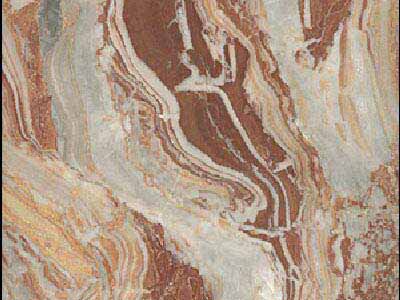
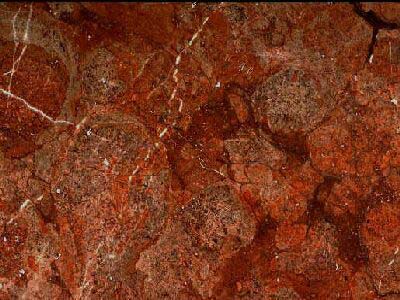
Corniola is a striking limestone originating from Italy, celebrated for its rich, warm red hues that range from terracotta to deep rust tones. This natural stone features a fine-grained texture that lends itself elegantly to both contemporary and classical architectural designs. Its captivating coloration makes it an ideal choice for interior cladding, flooring, and feature walls, bringing organic warmth to any space. To ensure quality and transparency, Marmi di Carrara supplies Corniola as rough blocks, precision-cut slabs in 2 or 3 cm thicknesses, and bespoke cut-to-size pieces. We provide high-resolution photographs of the actual slabs available for purchase, allowing architects and designers to verify the specific veining and color variations before committing to a order.
Petrographic description
This Italian limestone is characterized by a distinctive calcareous matrix and a deep red coloration resulting from iron oxide impurities, typically displaying a fine to medium grain structure with occasional organic inclusions.
Corniola is a Limestone quarried in Italy, catalogued in the Marmi di Carrara atlas under the international reference ICITLS00477. Its dominant tone is red.
Like every limestone, it is supplied as raw blocks, gangsaw slabs in 2 and 3 cm and cut-to-size pieces made in our Carrara plants. Recommended finishes: honed, brushed, sandblasted, bush-hammered, split-face. Typical applications: interior and exterior floors, façades, pool surrounds, garden design, carved elements.
Availability varies with the quarry campaigns: before quoting we check current stock, block sizes and the selection grade, and we send photos of the actual slabs. Price and transport are confirmed by our technical office within one working day.
Carnelian: the complete guide
Overview
Carnelian in slabs is a composite of orange and red chalcedony fragments bonded with resin. It is chosen for its warm colour and its translucency, which with backlighting turns the surface into a source of amber light.
History and origin
Carnelian is a variety of chalcedony, i.e. microcrystalline quartz, coloured by iron oxides. It has been used since antiquity for seals, engraved gems and ornaments. Today the stones, cut into small pieces, are reassembled into large-format slabs for interior architecture. Marmi di Carrara offers it on request, including in bespoke pieces.
Appearance
The irregularly shaped fragments range from light orange to brick red, with more transparent and more milky areas. The mosaic texture varies from slab to slab in the density and size of the pieces. Polished, it is brilliant and glassy; with light from behind the tones warm up and the resin joints become more visible.
Uses
It is at home in luminous walls, bar counter fronts, sculptural washbasins, coffee tables and decorative panels. Avoid floors, sun-exposed exteriors, because UV rays can yellow the resin, and hobs.
Care and maintenance
Lukewarm water and neutral soap with a microfibre cloth are all it needs. Do not use scouring pads, abrasive powders or solvents, which dull the resin.
- Classification
- semi-precious stone (chalcedony) in a composite slab
- Bulk density
- approx. 2,400-2,600 kg/m³ (indicative)
- Mohs hardness
- 6.5-7 for the fragments, resin softer
- Water absorption
- very low
- Main use
- interiors, decorative and backlit
- Acid resistance
- good for the chalcedony; the resin must be protected from solvents and heat
FAQ
Is Corniola suitable for outdoor use?
Limestone: suitable for façades and paving in temperate climates with a honed, brushed or bush-hammered finish. Tell us the climate and exposure of the project and we will recommend the right finish and thickness.
What is the price of Corniola per m²?
Indicative price from €110/m² for polished 2 cm slabs ex works Carrara, VAT excluded. The final figure depends on selection, block size, finish and quantity; a personalised quote is free.
How is Corniola shipped from Italy?
Slabs travel in wooden A-frames inside 20-foot containers (about 25 tonnes); blocks ship loose or in open-top containers. We quote FOB, CIF or door-to-door to any port or site.